Hôtel d’Aiguillon
An Officer and a SpyHôtel d’Aiguillon, an old building on the rue de l’Université, serves as the headquarters of the Statistical Section. Its unmarked entrance, shuttered windows, and decaying interior shelter a unit few people know exists. The same rooms that once hosted a literary salon become a workplace for surveillance and intelligence gathering, then the setting for Georges Picquart’s growing doubts about the case against Alfred Dreyfus. The building’s significance lies in that contrast: it is both the machinery of secret investigation and the enclosed space in which the machinery’s claims begin to come apart.
Identity and Historical Setting
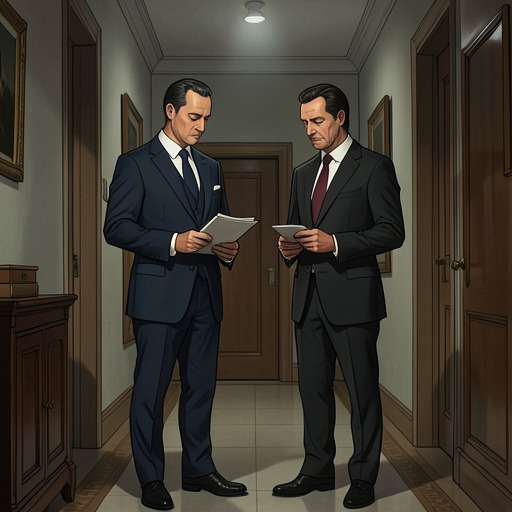
The building first appears to Georges Picquart as a grimy house he has often passed and assumed was derelict. Major Henry takes him there not through the ministry but from its back gate, a short walk up the road. The windows are heavily shuttered, the door has no nameplate, and the lobby carries the damp, musty smell of a neglected interior. Henry explains that Colonel Sandherr had stopped the building from being demolished, in part because its obscurity meant that nobody disturbed the unit there.
Louis Leblois later identifies the house as the former hôtel d’Aiguillon. Before the Revolution, the old Duchess Anne-Charlotte de Crussol Florensac held a literary salon there, where Montesquieu and Voltaire may have sat in the very room Picquart now occupies. The historical association lends the rooms an unexpected former life: a place once connected with public conversation and literary company now shelters an organization whose work depends on closed doors and restricted knowledge.
The novel’s setting is a literary reconstruction of a real political scandal. Its author’s note says that the characters are not wholly fictional and that most events occurred in some form, while also acknowledging invented personal details and a central conceit: Picquart never wrote the secret account that the novel imagines. The building’s scenes therefore belong to a historical novel, not a claim that every private encounter or interior detail is documentary fact.
Rooms and Working Methods
The Statistical Section occupies a bleak, compartmentalized interior. The first-floor passage receives almost no natural light because the doors are shut; electrical wiring has been installed crudely, without repairing the plaster around it, and a fallen piece of ceiling leans against the wall. Each man works alone behind his own closed door. The building’s arrangement is not merely atmospheric: it supports a culture in which information is divided among individual rooms, specialists, and files.
The staff’s tasks make that secrecy tangible. Captain Junck opens intercepted envelopes by steaming their glue over a gas flame, a method Henry calls a wet opening. In another room, Captain Valdant uses a scalpel and slender forceps to extract a rolled letter through small openings in the seal without leaving an obvious trace. On the floor above, Gribelin works among locked filing cabinets and instinctively hides what he is reading when Picquart appears. The procedures range from physical intrusion into private correspondence to the guarded preservation of the resulting records.
Picquart’s own office is unexpectedly small and dark, with drawn curtains, a large table, a locked steel filing cupboard, and a desk facing a tall window. When he pulls aside the dusty curtains, he discovers a view over the formal garden behind Hôtel de Brienne. His attention to topography helps him understand the sightline: from this angle, the minister’s office seems close enough that a telescope might bring it into view. The observation links the building’s obscure position to the nearby centers of military authority without making the office itself any less hidden.
Surveillance and Intelligence Work
The building is a point of connection between agents, informants, police work, and military command. Henry explains that the unit uses police agents, informers, and men with useful skills, keeping them occupied rather than leaving them on the streets. From this concealed base, Picquart receives François Guénée of the Sûreté, who has been monitoring the Dreyfus family. Guénée reports on Mathieu Dreyfus, Alfred’s older brother, and brings a file and photograph to the office briefing. The headquarters thus turns private family movements into an intelligence subject before Picquart has established what the evidence actually proves.
It also provides the administrative base for Operation Benefactor, Picquart’s surveillance operation targeting Esterhazy. He opens an active case file under that name and arranges for Ducasse to rent an apartment at 101 Rue de Lille, opposite the German Embassy in Paris at number 78. Desvernine visits Ducasse in disguise to explain the assignment; technical staff from the Sûreté deliver sealed cases of optical and photographic equipment and darkroom chemicals. Picquart later inspects the apartment himself. The operation extends the Section’s reach beyond its hidden rooms, but its planning and coordination begin at the Hôtel d’Aiguillon.
The office also receives accounts that feed into the case’s chain of suspicion. In Henry’s deposition, a report from the informant the marquis de Val Carlos warns that a French officer on the General Staff has been supplying information to German and Italian military attachés, without identifying the officer. Guénée’s earlier exchange with Val Carlos, and Picquart’s later interview with the marquis, pass through the intelligence network serviced by the Section. At the Hôtel d’Aiguillon, such leads acquire the appearance of formal knowledge through reports and files even when they do not name a suspect or establish guilt.
The Archive and the Limits of Secrecy
The building’s locked cabinets preserve not only official reports but material that can challenge the conclusions built from them. When Picquart examines the five documents in the secret file, he finds circumstance and innuendo rather than a direct witness or document identifying Alfred Dreyfus as a traitor. The nearest apparent link is an initial, D. The file’s contents make the room’s archival order look less like a guarantee of proof than a way of giving fragmentary claims the authority of a dossier.
During a clandestine search of the cabinets, Picquart gathers material associated with Agent Auguste. The papers include letters and telegrams from Berlin, correspondence involving German, Italian, and Austro-Hungarian officials, an envelope of cinders dated November 1890, and intimate letters from Hermance de Weede and Alessandro Panizzardi. Their presence reveals how much personal and diplomatic material the Section has accumulated and kept out of public view. Picquart sorts the documents, notes where each came from, and returns them to their places before replacing Gribelin’s keys. The archive is at once a storehouse of intelligence and a carefully controlled environment in which unauthorized discovery must leave no trace.
One cross-reference proves decisive. Among letters from Panizzardi to Maximilian von Schwartzkoppen, Picquart finds a note saying that Panizzardi had seen M. Dubois. Following the reference leads to a report by Major Henry identifying Jacques Dubois as a possible source of plans, while also concluding that he had no access to classified material and that the plans he supplied were publicly available. Picquart recognizes the consequence: the D implicated in this trail is Dubois, not Dreyfus. The correction emerges from the Section’s own files, preserved in the same building that had helped sustain suspicion of Dreyfus.
Narrative Significance
Hôtel d’Aiguillon concentrates the book’s conflict between secrecy and verification in a single location. The Section can open envelopes without marks, keep agents and informants at work, file reports, and lock documents away; those same methods do not ensure that its conclusions are true. The rooms make surveillance practical, while their archives preserve evidence capable of exposing the errors and omissions produced by surveillance.
The building’s movement from salon to intelligence headquarters sharpens the contrast between exchange and concealment. In the former salon’s rooms, information is now screened, compartmentalized, and controlled. Yet the old house cannot keep every secret contained: people carry reports beyond its walls, a secret file leaks, and Picquart finds evidence in its cabinets that undermines the accusation against Dreyfus. Hôtel d’Aiguillon is therefore more than a backdrop for the investigation. It is the enclosed institutional space where the case’s secret knowledge is assembled, distorted, and, through Picquart’s scrutiny, turned against its own assumptions.